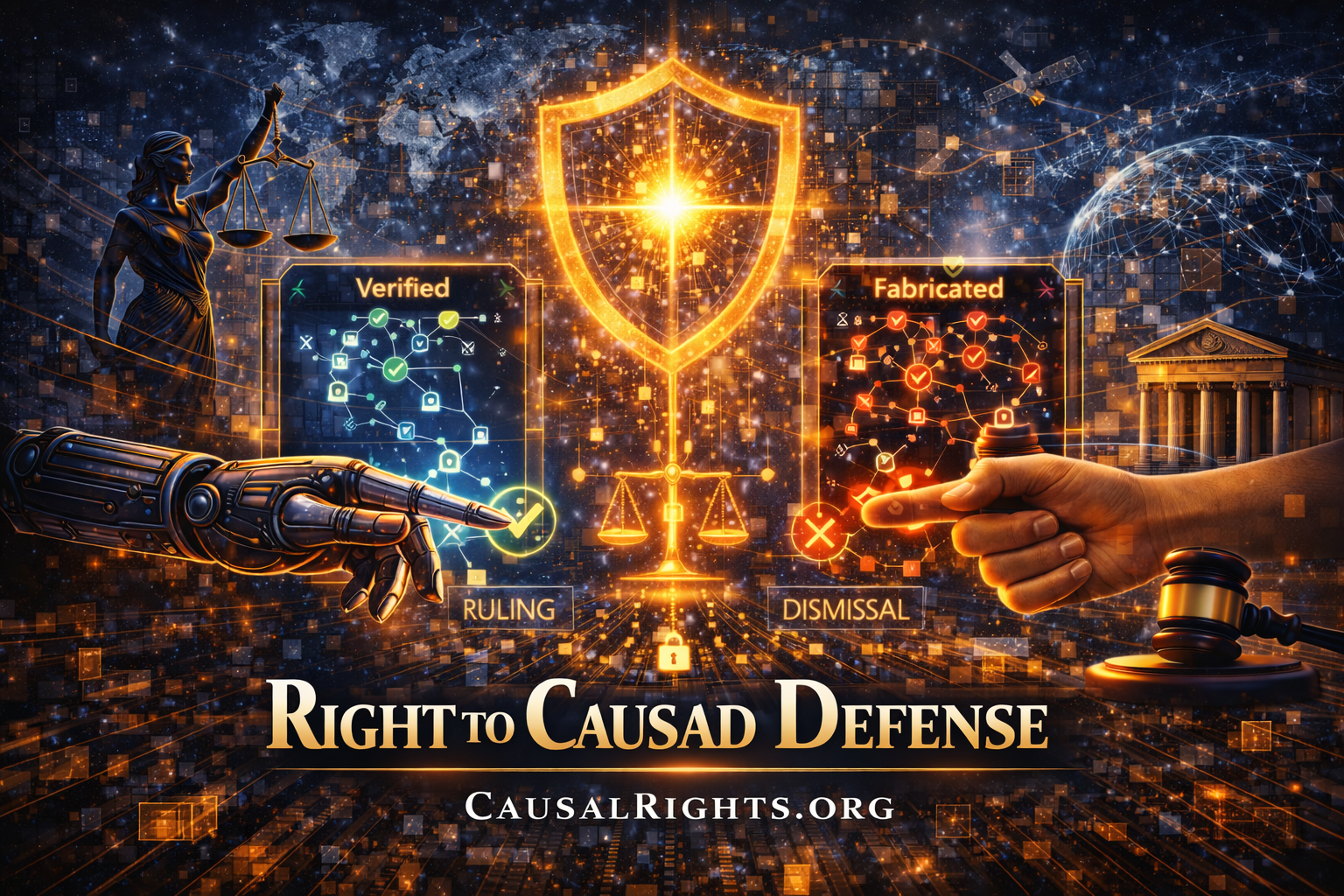
Every person has the right to cryptographically prove they DID create specific cascades—and that others did NOT create cascades they claim.
What This Right Protects
Legal standing to present cascade proof in causation disputes, with courts required to accept cryptographic verification as evidence. When someone claims causation they didn’t create, you can challenge through mathematical cascade analysis showing fabrication patterns. When you created genuine cascades, you can defend attribution against institutional narratives attempting erasure.
This right has dual structure: affirmative defense (proving you caused what you claim through cryptographic attestations, temporal verification, and cascade patterns) and negative defense (proving others did not cause what they claim through absence of verification, failed temporal tests, or synthetic cascade signatures).
Courts must treat cascade proof as strongest form of causation evidence—cryptographic attestations from beneficiaries override testimony, temporal persistence data exceeds behavioral observation, and cascade branching patterns trump institutional documentation in causation disputes.
Employers must consider cascade proof in hiring and promotion decisions. Cannot dismiss verified capability cascades as irrelevant when making personnel decisions. Markets must have access to cascade verification when evaluating attribution claims. Professional organizations must recognize cascade proof in credentialing and certification.
Without defense rights, cascade proof becomes interesting data lacking legal force. You accumulated cryptographic verification but courts ignore it. Employers see cascade evidence but dismiss it as unverified. Competitors make false attribution claims but face no consequence when cascade analysis proves fabrication.
Defense capability makes causal rights enforceable rather than aspirational. Rights without enforcement are suggestions. Defense transforms cascade proof from documentation into legally actionable evidence creating consequences for false attribution and protection for genuine causation.
Why This Is Fundamental
Rights that cannot be defended in courts are not rights—they are permissions revocable when convenient.
You accumulated cascade proof across decades. Employer claims your contributions were institutional property. You present cryptographic attestations from 94 colleagues confirming your specific causation. Court dismisses cascade proof as ”unverified data” because no legal framework requires judicial recognition. Result: you lose despite having definitive proof because proof lacks legal standing.
Competitor fabricates cascade claims, generating synthetic attestations through AI. You analyze cascade patterns revealing fabrication signatures—no temporal persistence, no beneficiary independence, no multiplication patterns. But legal system has no framework for cascade analysis, no standards for distinguishing genuine from synthetic. Result: fabrication succeeds because defense mechanisms don’t exist.
This is why defense rights are constitutional necessity:
Without legal recognition, cascade proof provides personal verification but no institutional power. With legal recognition, cascade proof becomes courtroom evidence, employment documentation, market signal, and professional credential—creating actual consequences for false attribution and actual protection for genuine causation.
The enforcement asymmetry without defense rights:
Powerful actors fabricate attribution. Control institutional narratives. Manufacture credentials. Generate synthetic cascade claims. Face no consequence because legal frameworks don’t recognize cascade analysis methods proving fabrication.
Genuine creators accumulate verification. Document actual causation. Build cryptographic proof. Gain no protection because courts don’t accept cascade evidence, employers don’t credit verification, markets don’t access proof.
Result: False attribution succeeds while genuine causation remains unprotected—precisely opposite of what rights framework should enable.
Defense rights reverse this asymmetry. False attribution faces exposure through cascade analysis showing fabrication. Genuine causation gains protection through cryptographic proof courts must accept. Consequences flow to fabricators while protection flows to actual creators.
Implementation Requirements
Judicial recognition mandate: Courts must accept properly-structured cascade verification as admissible evidence in causation disputes. Cryptographic attestations from beneficiaries carry evidentiary weight equal to or exceeding sworn testimony. Temporal persistence data constitutes proof of sustained causation. Cascade branching patterns demonstrate genuine capability transfer.
This requires: legal standards defining valid cascade proof structure, judicial training in cryptographic verification interpretation, expert witness frameworks for cascade analysis testimony, and precedent establishing cascade evidence superiority over behavioral observation when they conflict.
Employment law integration: Hiring and promotion decisions must consider verified cascade proof when candidates present it. Employers cannot dismiss cryptographic verification as irrelevant. When cascade evidence contradicts institutional narrative about capability, courts can compel employers to justify decisions despite contrary verification.
This doesn’t mandate hiring based on cascades but prevents systematic dismissal of verified proof. Employer can choose candidate without cascade verification over candidate with extensive proof—but must justify decision when challenged, cannot claim cascade verification is meaningless or unverifiable.
Market access requirements: When markets evaluate contribution claims—investment decisions, professional reputation, expert credibility, thought leadership—cascade verification must be accessible and cannot be suppressed. Cannot prevent verified creators from presenting cascade proof while allowing unverified claims to circulate freely.
This means: professional networks cannot hide cascade verification while promoting unverified profiles, media cannot exclude verified attribution while citing unverified sources, industry rankings cannot ignore cascade proof while accepting self-reported claims.
False attribution liability: Making provably false cascade claims becomes legally actionable. If you claim contributions that cascade analysis definitively disproves—showing no beneficiary attestations, failed temporal verification, synthetic cascade signatures—you face liability similar to fraud or defamation.
Standard: preponderance of evidence showing cascade claim fabricated (more likely false than true based on verification absence). Consequences: damages for harm caused by false attribution, injunctive relief preventing continued false claims, professional sanctions in credentialed fields, market corrections informing those misled by fabrication.
Defense funding mechanisms: When individuals with limited resources face attribution disputes against well-funded opponents, legal aid or pro bono support must be available for cascade proof presentation. Cannot make defense rights accessible only to wealthy who can afford expert witnesses and legal teams.
This parallels public defender systems—constitutional right to present defense means ensuring access to defense mechanisms regardless of economic resources. Cascade proof presentation requires cryptographic expertise, temporal analysis capabilities, and legal representation—these must be accessible to those defending genuine causation against institutional erasure attempts.
Real-World Application
Scenario: Patent attribution dispute
Inventor files patent based on research breakthrough. University claims invention resulted from institutional collaboration deserving shared ownership. Inventor presents cascade records showing specific capability transfers to colleagues who confirmed inventor’s unique contributions 18 months before university collaboration began.
Without Causal Defense Rights: Court has no framework for evaluating cascade evidence. University’s institutional documentation carries more weight than individual’s cryptographic proof. Inventor loses despite definitive verification because cascade evidence lacks legal standing.
With Causal Defense Rights: Court accepts cascade attestations as evidence. Temporal verification showing inventor’s contribution preceded institutional involvement by 18 months becomes legally persuasive. University must rebut cryptographic proof not just present competing narrative. Inventor wins based on verified causation timeline.
Scenario: False credential exposure
Job candidate claims extensive teaching experience with verified capability transfers to hundreds of students. Employer skeptical performs cascade analysis. Discovers: no beneficiary attestations (all synthetic), failed temporal verification (claimed students show no independent capability), cascade patterns inconsistent with genuine teaching (no multiplication, no persistence, no independence).
Without Causal Defense Rights: Employer suspicious but cannot legally act on cascade analysis. No framework for challenging false credentials through verification methods. Candidate might be fabricating but employer cannot prove it legally. Hiring decision remains uncertain.
With Causal Defense Rights: Employer presents cascade analysis showing fabrication. Candidate cannot produce genuine beneficiary attestations. Temporal verification reveals claimed capabilities don’t persist in supposed students. Court accepts analysis as proof of false credentials. Candidate faces liability for fraud, employer protected from negligent hiring claims.
Scenario: Contribution erasure resistance
Employee’s genuine contributions systematically erased by employer taking credit. Employee accumulated cryptographic attestations from 67 colleagues confirming specific capability transfers. Employer claims contributions were team efforts deserving no individual attribution.
Without Causal Defense Rights: Employee’s cascade proof interesting but legally irrelevant. Employment dispute resolved through institutional documentation and testimony. Employer controls narrative, employee’s verification dismissed as unverified data. Employee loses despite cryptographic proof.
With Causal Defense Rights: Employee presents cascade evidence in legal proceedings. Court must evaluate cryptographic attestations from 67 colleagues against employer’s narrative. Temporal verification showing employee’s approaches persisted in colleagues’ work 2+ years later carries legal weight. Employee wins based on verified causation despite employer’s institutional power.
What Collapses Without This Right
Cascade verification becomes legally powerless. You accumulated perfect cryptographic proof but courts ignore it. Employers dismiss it. Markets don’t access it. Verification exists but creates no consequences for false attribution and no protection for genuine causation.
False attribution succeeds systematically. Fabricators make synthetic claims. Cascade analysis proves fabrication. But legal system has no framework for recognition. Fabrication continues unchallenged because verification methods lack legal standing.
Institutional narratives override cryptographic proof. Organizations control documentation, shape testimony, manufacture evidence. Individuals present cryptographic verification contradicting institutional narrative. Courts favor institutional weight over individual proof because cascade evidence not legally recognized.
Attribution disputes become unfalsifiable. He-said-she-said scenarios where both parties claim causation. Cascade proof could resolve definitively—showing who created verified capability transfers, whose claims lack temporal persistence, whose cascades show fabrication patterns. But without defense rights, disputes remain unresolvable even when cryptographic proof exists.
Rights without enforcement become performative. You have ”right” to causal proof, cascade ownership, portable verification, beneficiary attestation, temporal continuity, and inheritance—but cannot defend these rights in courts. Rights become suggestions you’re welcome to follow but institutions can ignore without consequence.
This is why defense capability is fundamental rather than procedural detail. All previous rights become meaningful only when enforceable through legal defense mechanisms. Without defense rights, causal rights framework becomes aspirational philosophy lacking institutional power.
Causal defense is not litigation encouragement or adversarial culture. This is essential enforcement mechanism making rights function in practice rather than existing only formally.
When courts accept cascade proof and false attribution faces consequences, verification infrastructure creates actual protection for genuine causation. When courts ignore cascade evidence and fabrication goes unchallenged, verification becomes interesting documentation lacking legal force.
Defense rights mean your existence becomes legally provable when you created genuine cascades. Without defense rights, existence remains provable only to those voluntarily accepting cascade verification—which excludes exactly the adversarial contexts where proof matters most.
Implementation Status: Legal frameworks for cascade evidence emerging slowly. Judicial training in cryptographic verification limited. False attribution liability standards undefined. Timeline: 2027-2033.
Related Rights: Article I (Right to Causal Proof), Article II (Right to Cascade Ownership), Article IV (Right to Beneficiary Attestation)