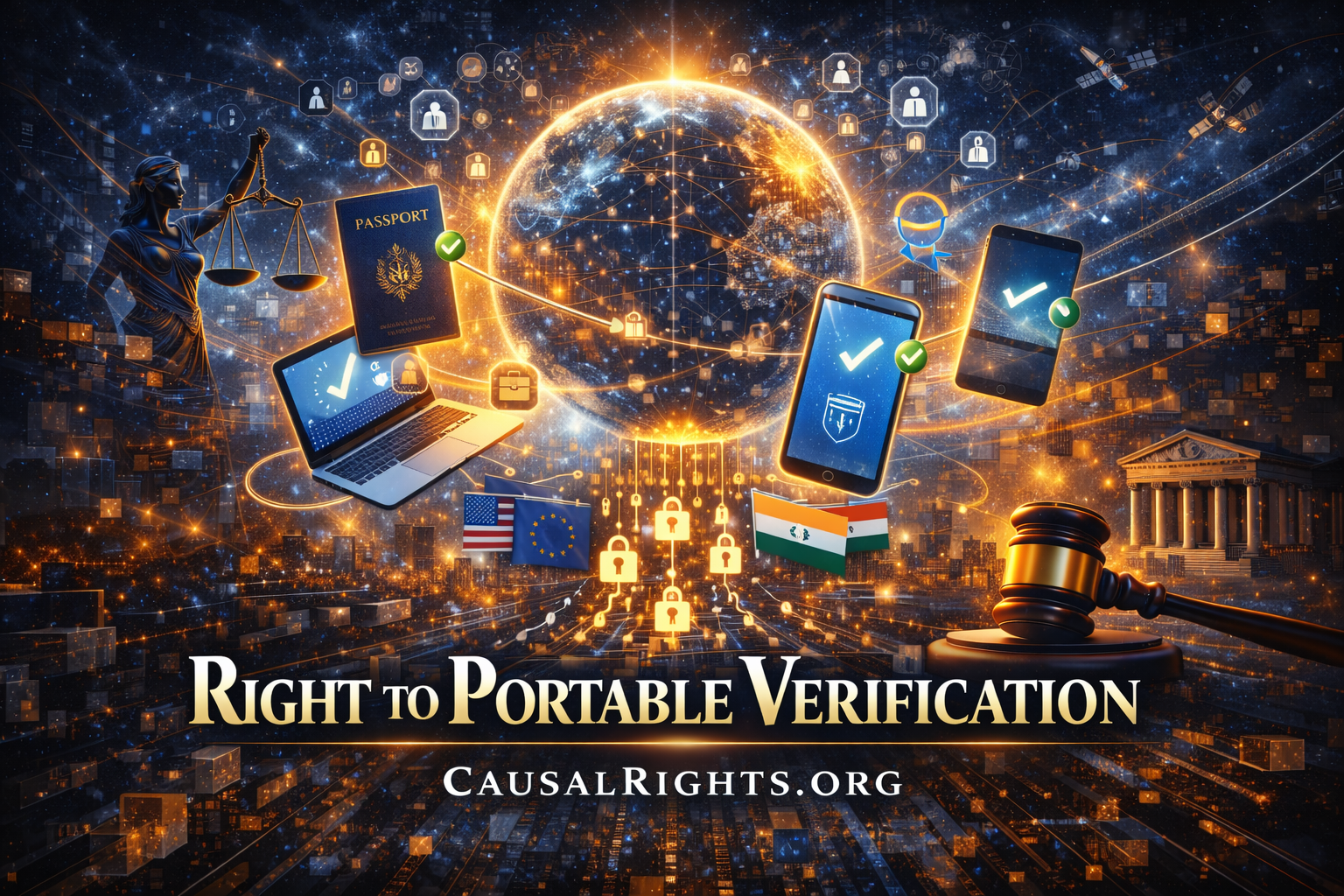
Every person’s capability cascades must be portable across all platforms, all borders, all contexts, verifiable everywhere, forever.
What This Right Protects
Universal recognition of cryptographically-verified cascades regardless of where they were created, where you currently reside, or which systems you choose to use. Your cascade proof travels with you to every job application, every institutional evaluation, every jurisdictional border, every platform transition—verifiable everywhere, accepted universally, functioning perpetually.
No system may refuse to recognize properly-structured cascade verification. No border may prevent cascade records from crossing. No platform may require you use their proprietary verification format. No jurisdiction may invalidate cryptographic attestations created elsewhere.
Portability means verification infrastructure becomes universal protocol rather than platform-specific feature. Like email works across all providers or web standards function in all browsers, cascade verification operates identically everywhere. Create proof once, use anywhere, recognized universally.
Without portability protection, you face fragmentation: cascade records valid in one context become useless in others. Professional history documented through employer’s system inaccessible to future employers using different platforms. Educational verification accepted domestically but rejected across borders. Capability proof requiring translation, re-verification, or re-accumulation for each new context.
This creates impossibility: you must rebuild verification infrastructure with every job change, platform switch, border crossing, or institutional transition. Your causation remains genuine but proof becomes context-specific—making verification practically unavailable despite technically existing.
Why This Is Fundamental
Verification without portability is not verification—it is permission.
When cascade proof only functions within single platform, that platform controls whether your causation becomes provable. LinkedIn accepts your contribution graph but employer requires verification through different system? Your causation exists but becomes unprovable in context where it matters most.
When verification only works domestically, international opportunities become inaccessible despite genuine capability. You created verified capability cascades across decade but different country requires different verification format? Your expertise exists but cannot be proven when relocating.
When employers cannot recognize cascade proof from previous employers, professional mobility stops. You spent five years accumulating verified contributions but new employer only accepts verification through their proprietary system? Your capability development becomes invisible, requiring reconstruction from zero despite substantial existing proof.
The fragmentation creates platform capture through verification lock-in:
Platform A accumulates your cascade data. Platform B uses incompatible format. Switching means losing verification history or maintaining parallel presence on both platforms indefinitely. Platform lock-in occurs not through quality differences but through verification incompatibility—you remain on inferior platform because switching means losing proof of your causation.
Employer A documents your contributions. Employer B cannot read Employer A’s verification format. Changing jobs means your previous contributions become unprovable, forcing you to accept lower compensation reflecting zero verified capability despite substantial actual experience.
Country A accepts certain verification standards. Country B requires different format. Migration means your professional history becomes unverifiable, starting career over despite decades of actual capability development.
This is Web2 capture pattern applied to verification infrastructure:
Facebook owns your social graph, making leaving Facebook mean losing connections. LinkedIn owns your professional network, making switching platforms mean losing professional relationships. Platforms captured value by making data non-portable—you created connections but cannot take them elsewhere.
Cascade verification without portability follows identical pattern. Platforms and institutions capture your professional identity by making verification context-specific. You created causation but cannot prove it outside their systems—giving them permanent leverage over your professional mobility.
Portability protection prevents this capture. Cascade records in standardized format readable by all systems. Cryptographic verification accepted universally. Professional history portable across platforms, borders, and institutional contexts. Create proof once, use everywhere—the fundamental requirement for verification functioning as right rather than platform privilege.
Implementation Requirements
Universal standards mandate: International bodies must establish cascade verification standards that all signatory nations recognize legally. Like how passports function globally or payment networks operate across borders, cascade verification becomes internationally standardized protocol.
Standards must specify: cryptographic signature formats ensuring unforgeable attestation, temporal verification methodologies enabling persistence testing, beneficiary attestation structures proving direct confirmation, cascade branching patterns demonstrating multiplication, and data formats enabling cross-platform compatibility.
No jurisdiction may create proprietary extensions making their cascade data incompatible with international standards. Countries can add supplementary information but cannot break interoperability. Similar to how nations can add visa requirements but cannot make passports unreadable across borders.
Platform interoperability requirements: Services operating in jurisdiction must accept standardized cascade verification formats. Employer using System A cannot reject cascade proof from System B if both follow international standards. Platform preference allowed but verification rejection based on format incompatibility prohibited.
This prevents competitive moating through incompatibility. Platforms can differentiate on features, user experience, or analytical capabilities—but cannot refuse valid cascade verification because it originated elsewhere. Verification portability becomes table stakes, not competitive advantage.
Cross-border recognition treaties: Nations must establish mutual recognition agreements accepting cryptographic cascade verification from signatory countries. Your cascade proof created in Sweden functions in Singapore, Canada, Brazil without requiring re-verification, translation, or institutional mediation.
Treaties specify minimum standards cascade verification must meet—cryptographic security levels, temporal verification rigor, beneficiary attestation requirements, independence confirmation methods. Meet standards and verification functions globally. Fail standards and recognition optional.
Legal enforcement mechanisms: Courts must accept portable cascade verification as evidence regardless of origin platform, jurisdiction, or institutional source. Employers cannot require proprietary verification formats. Educational institutions cannot demand platform-specific credentials. Governments cannot restrict cascade portability across borders.
Violations face legal consequence. Platform refusing portable verification faces regulatory sanctions. Employer demanding proprietary formats faces discrimination claims. Government preventing cascade export faces human rights violation charges.
Real-World Application
Scenario: International career mobility
Engineer accumulates 12 years verified capability cascades working in Germany. Receives job offer from Singapore employer who uses different verification platform. German employer’s system incompatible with Singaporean platform standards.
Without Portable Verification: Engineer’s cascade history locked in German system. Singapore employer cannot access or verify previous contributions. Engineer appears entry-level despite substantial expertise. Compensation reflects zero verified capability forcing significant salary reduction or job rejection.
With Portable Verification: Engineer exports cascade records in international standard format. Singapore employer imports verification into their system. Cryptographic attestations from 94 German colleagues readable universally, temporal verification data compatible across platforms. Compensation reflects actual verified capability. Professional history portable despite platform and jurisdictional differences.
Scenario: Platform migration
Professional network accumulates cascade verification for decade. Platform quality degrades, privacy policies change, or superior alternative emerges. Professional wants to switch but fears losing verification history.
Without Portable Verification: Cascade records trapped in original platform’s proprietary format. Alternative platform cannot import history. Switching means losing decade of verified contributions. Professional remains on degrading platform because lock-in too costly.
With Portable Verification: Professional exports complete cascade history in standardized format. Alternative platform imports records seamlessly. Cryptographic signatures remain valid, temporal data persists, beneficiary attestations transfer intact. Switching preserves full verification history—platform lock-in eliminated through portability.
Scenario: Academic credential recognition
Researcher completes doctorate in Brazil with verified cascade of capability transfers to students and colleagues. Applies for faculty position in United States. University requires verification through American credentialing systems.
Without Portable Verification: Brazilian cascade verification incompatible with US systems. Researcher must obtain separate US credential evaluation, potentially repeat examinations, or accept positions below qualification level. Capability exists but verification non-portable makes it institutionally invisible.
With Portable Verification: Brazilian cascade records conform to international standards. US university imports verification directly. Cryptographic attestations from Brazilian students readable by US systems. Temporal verification demonstrates capability persistence across years. Faculty hiring reflects actual verified expertise rather than bureaucratic re-verification requirements.
What Collapses Without This Right
Professional mobility stops. Cannot change jobs, platforms, or jurisdictions without losing verification history. Career advancement requires maintaining presence in original verification system indefinitely—even when system degrades, platforms fail, or better alternatives exist.
Platform lock-in intensifies. Verification fragmentation creates switching costs exceeding any quality differences. Platforms capture users not through superior service but through verification incompatibility. Competition on quality disappears when leaving means losing professional identity.
International barriers strengthen. Cannot relocate professionally because cascade verification doesn’t cross borders. Global talent mobility collapses when expertise becomes unprovable outside origin jurisdiction. Nations fragment into incompatible verification zones.
Innovation stagnates. Better verification platforms cannot compete because users locked into existing systems through non-portable history. Verification infrastructure ossifies around first-mover platforms rather than improving through competition.
Institutional power consolidates. Organizations controlling verification infrastructure gain permanent leverage. Professional identity depends on maintaining institutional relationships rather than actual capability. Power asymmetry where institutions can deny portability creates dependency exceeding employment relationship.
This is why portability is fundamental rather than convenience feature. Without portability, cascade verification becomes another mechanism for institutional capture—you created causation but cannot prove it except through systems controlled by those with interest in denying your mobility.
With portability, verification enables actual professional sovereignty. Create proof once, use everywhere, recognized universally. Your causation becomes provable independent of platform cooperation, institutional permission, or jurisdictional constraints.
Portability is not about data formats or technical standards. This is about whether verification infrastructure enables proving your existence universally or fragments into permission systems where each context requires separate institutional approval.
Portable verification means conscious existence becomes provable everywhere. Fragmented verification means existence remains context-specific—real in some systems, unprovable in others, creating civilization where personhood itself becomes jurisdictional rather than universal.
Implementation Status: Standards development active through W3C and international working groups. Treaty negotiations beginning. Platform resistance significant. Constitutional recognition required for enforcement. Timeline: 2026-2032.
Related Rights: Article I (Right to Causal Proof), Article II (Right to Cascade Ownership), Article V (Right to Temporal Continuity)