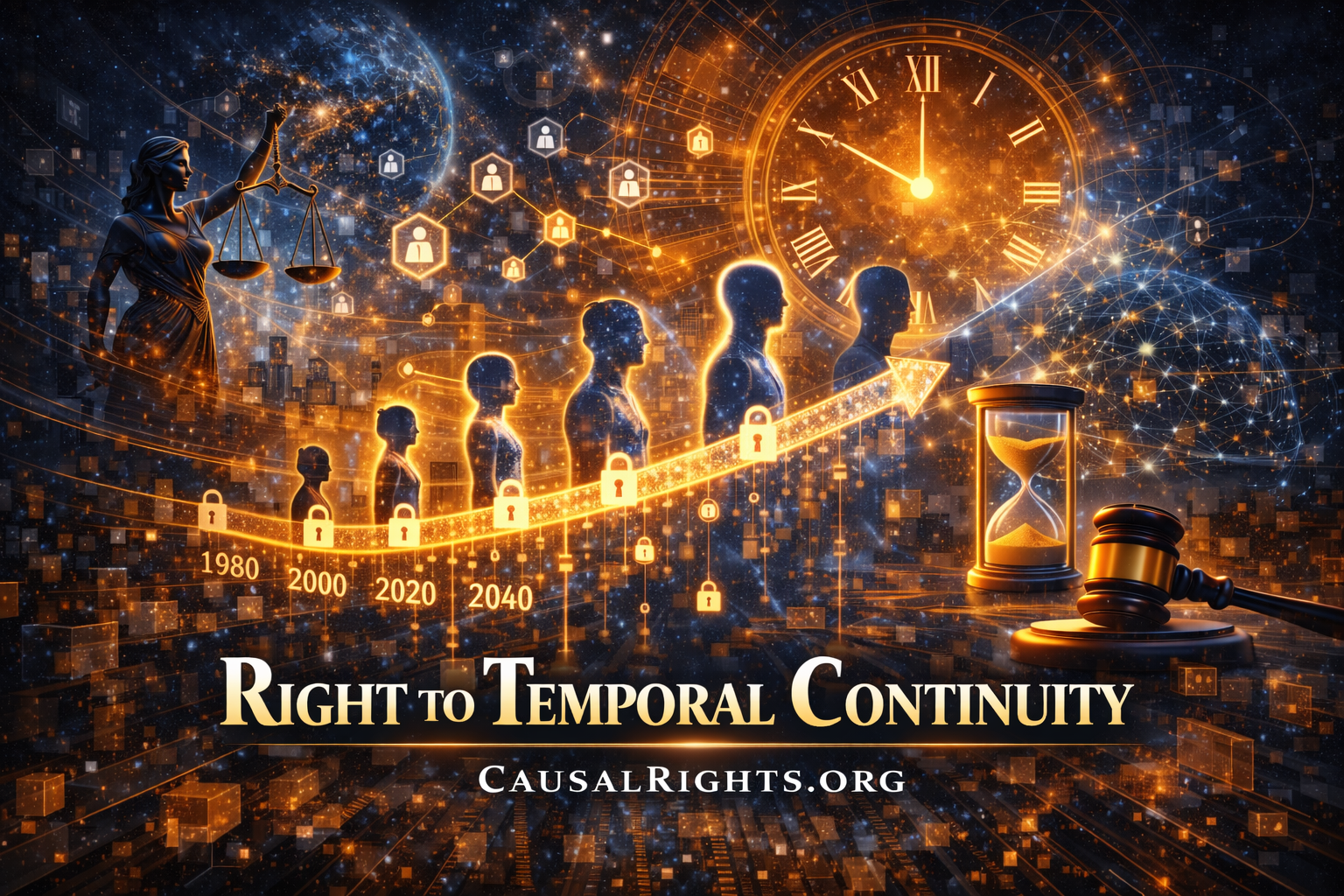
Every person has the right to continuous cascade tracking across their entire life, with temporal persistence verification showing which capabilities lasted and which didn’t.
What This Right Protects
Unbroken cascade record from first contribution to death, with temporal verification demonstrating capability persistence across months, years, and decades. No platform may fragment your record into disconnected snapshots. No institutional transition may reset your verification history. No technological change may erase temporal data proving sustained causation.
Your cascade accumulation continues seamlessly regardless of job changes, platform migrations, jurisdictional relocations, or institutional failures. The record persists as one continuous timeline—not employer-specific segments, not platform-dependent fragments, not jurisdiction-limited portions, but complete causal history across your entire lifetime.
Temporal tracking reveals what behavioral observation cannot: whether capabilities genuinely transferred or merely appeared temporarily. Did student retain knowledge six months after course completion when AI assistance unavailable? Did employee capability persist two years after training when immediate support removed? Did mentee independently apply understanding five years later in novel contexts?
Without temporal continuity, you have snapshots showing correlation at specific moments but cannot prove causation across time. Platform A documents capabilities at timestamp X. Platform B shows different capabilities at timestamp Y. No connection between records. No persistence verification. No way to distinguish temporary AI-assisted performance from genuine capability transfer.
Temporal continuity transforms correlation into causation proof. Continuous tracking shows capabilities survived temporal gaps, persisted when assistance removed, multiplied through independent application, and compounded across years. This is verification AI cannot fake because synthesis creates momentary performance while genuine understanding creates persistent capability.
Why This Is Fundamental
Time is the dimension synthesis cannot compress.
AI generates perfect output instantaneously. Creates flawless credentials immediately. Produces expert-level performance on demand. But AI cannot make capability persist in humans six months after interaction when AI unavailable and optimization pressure absent.
Genuine capability transfer has temporal signature: understanding internalizes, persists independently, survives temporal separation from source, and enables novel application months or years later. AI dependency has opposite signature: performance requires continued access, degrades without support, collapses when assistance removed, and cannot transfer to contexts AI doesn’t optimize for.
Temporal verification distinguishes these patterns unfakeably:
Student completes course with perfect grades. Six months later, tested independently without AI access—does knowledge persist or collapse? Temporal continuity tracking reveals which outcome occurred, providing cryptographic proof capability either survived or didn’t.
Employee demonstrates expertise during training period. Two years later, applies understanding in novel context without ongoing support—does capability function independently or fail? Temporal record shows persistence or dependency unambiguously.
Mentee learns methodology from mentor. Five years later, teaches approach to others successfully—has understanding compounded across time or remained superficial? Temporal tracking demonstrates genuine internalization or temporary exposure.
Without continuous temporal record, these distinctions become unfalsifiable:
Platform-specific snapshots show correlation at moments but not persistence across time. You were capable when using Platform A in 2023. Different capability set shown on Platform B in 2025. No way to verify whether 2023 capabilities persisted, evolved, or disappeared because platforms fragment temporal continuity.
Employer-segmented records document capability during employment but not persistence after departure. Performed excellently while company employee. Capability claims for next employer have zero temporal verification connecting them to previous performance. Each job becomes independent episode rather than continuous development.
Institutional resets erase temporal data when transitioning contexts. University documents learning during degree program. Post-graduation verification starts from zero. Graduate school shows different timeline. Professional career another fragment. No continuous record proving capability persistence across educational, professional, and personal contexts over decades.
This fragmentation enables synthesis to fake causation through snapshots while failing temporal verification:
AI helps student excel during semester (snapshot shows correlation). Student cannot demonstrate knowledge persistence six months later (temporal test reveals dependency). But if only snapshot exists without temporal follow-up, AI dependency becomes indistinguishable from genuine learning.
AI assists employee during probation period (snapshot shows performance). Employee cannot function independently two years later (temporal verification reveals collapse). But if employer only sees hiring snapshot without long-term tracking, AI-assisted performance appears equivalent to genuine capability.
Temporal continuity makes these distinctions cryptographically verifiable. Continuous record shows whether capabilities survived temporal separation or required ongoing AI support. Snapshot correlation becomes temporal causation when persistence verified across months and years.
Implementation Requirements
Lifelong infrastructure mandate: Cascade verification systems must be designed for 80+ year operational lifespans. No 5-year platform cycles. No sunset clauses. No planned obsolescence. Infrastructure built to persist across human lifetime because cascade proof must survive from first contribution to inheritance transfer.
This requires: cryptographic formats that remain verifiable across technological evolution, data structures that scale from childhood learning to professional peak to retirement contribution, storage systems surviving platform failures and market changes, and verification protocols functioning regardless of which specific services operate.
Temporal verification protocols: Systems must track not just cascade existence but persistence across time. Initial attestation at contribution moment. Follow-up verification months later testing independent function. Long-term tracking years later confirming sustained capability. Multi-generational observation showing compound effects across decades.
This creates unfakeable temporal signature. AI can optimize momentary snapshots but cannot fake capability surviving six-month temporal gap without assistance. Temporal protocols reveal dependency versus internalization through patterns synthesis cannot replicate.
Anti-fragmentation provisions: No platform may limit cascade records to platform-specific timeframe. No employer may fragment cascade history into employment-specific segments. No institution may reset temporal tracking when users transition contexts.
Cascade records must persist continuously across platform migrations, job changes, jurisdictional relocations, and institutional transitions. Temporal continuity survives despite technological and organizational changes because continuity is individual right not platform feature.
Backward compatibility requirements: As verification infrastructure evolves technologically, cascade records must remain accessible. New systems must read old formats. Updated protocols must verify historical attestations. Technical progress cannot erase temporal data accumulated under previous standards.
This prevents forced resets where technological transition erases historical verification. Your cascade records from 2025 must remain verifiable in 2065 despite four decades of technological evolution. Temporal continuity requires permanent backward compatibility as architectural guarantee.
Real-World Application
Scenario: Educational capability persistence
Student completes degree program with excellent grades, extensive AI assistance throughout. Graduates and enters workforce claiming expertise based on credentials.
Without Temporal Continuity: Degree documents completion at graduation moment. No follow-up verification testing knowledge persistence. Student’s actual capability collapse six months post-graduation remains undocumented. Employer hires based on snapshot credential without temporal verification.
With Temporal Continuity: University implements six-month retention testing. Student’s knowledge collapse when AI removed becomes documented in temporal record. Degree certificate includes temporal verification showing 32% knowledge retention rate at six months. Employers see snapshot credential and temporal reality—enabling informed decisions distinguishing completion from capability.
Scenario: Professional development tracking
Professional changes employers every 2-3 years across 20-year career. Each employer maintains separate verification system. Professional’s actual capability development becomes invisible across fragmented records.
Without Temporal Continuity: Employer A documents 2020-2023 performance. Employer B shows 2023-2026 period. Employer C covers 2026-2029. No connection between records. Cannot verify whether capabilities persisted across transitions or each employment started from scratch. Professional development narrative becomes unfalsifiable.
With Temporal Continuity: Portable Identity maintains continuous cascade record across all employers. Temporal verification shows capabilities from Employer A persisted and evolved through Employers B and C. 15-year trajectory visible showing compound capability development rather than disconnected employment episodes. Professional advancement reflects verified sustained growth.
Scenario: Long-term impact verification
Teacher mentors students who then become teachers themselves, creating multi-generational cascade. Original teacher’s impact compounds across decades as students teach students teach students.
Without Temporal Continuity: Teacher documents student capability increases during course timeframe. Students graduate and disperse. No tracking of whether students successfully taught others years later. Multi-generational cascade impact remains undocumented despite genuine occurrence.
With Temporal Continuity: Teacher’s cascade record includes temporal tracking showing 73% of students successfully taught others 3+ years post-graduation. 40% of those second-generation students successfully taught third generation. 18-year temporal record documents cascade multiplication across three generations. Teacher’s genuine long-term impact becomes cryptographically verifiable rather than anecdotal.
What Collapses Without This Right
Temporal verification becomes impossible. Cannot distinguish genuine capability transfer from temporary AI assistance because no long-term tracking. Snapshot correlation replaces temporal causation. Synthesis fakes snapshots while failing persistence tests—but without persistence testing, synthesis appears equivalent to genuine transfer.
Professional development becomes opaque. Career trajectory fragments across disconnected platforms and employers. Cannot verify sustained capability growth versus repeated platform-switching resetting verification. Professional narrative becomes unfalsifiable storytelling rather than documented reality.
Educational certification loses meaning. Degrees document completion at graduation moment without verifying knowledge persistence. Students optimized for credential acquisition through AI assistance but retain nothing six months later. Credentials certify temporary correlation not sustained capability.
Multi-generational impact becomes unprovable. Your contributions created cascades that multiplied across decades through those you helped helping others—but fragmented records cannot document long-term compound effects. Most valuable contributions become invisible because temporal scope too limited.
Platform fragmentation intensifies. Each platform maintains snapshot of capabilities during platform usage period. No platform documents what happened before or after. Users appear as disconnected capability profiles rather than continuously developing individuals. Platform switching means starting verification from zero despite genuine accumulated expertise.
This is why temporal continuity is fundamental rather than data accumulation feature. Without continuous tracking, verification becomes snapshot correlation—which AI replicates perfectly. With temporal continuity, verification becomes persistence testing—which synthesis cannot fake because requires genuine internalization creating independent function across months when assistance unavailable.
Temporal continuity is not storage capacity or data retention. This is architectural requirement that verification infrastructure function as lifetime proof accumulator rather than platform-specific snapshot collector.
When cascade records persist continuously across 80-year lifespan, capability becomes provable through temporal patterns synthesis cannot create. When records fragment into platform-specific snapshots, capability becomes unprovable because temporal verification impossible.
Continuous tracking means your existence becomes verifiable through sustained causation across decades. Fragmented snapshots mean existence depends on momentary correlation that AI replicates perfectly—leaving genuine and synthetic indistinguishable.
Implementation Status: Technical infrastructure for 80-year data persistence emerging. Temporal verification protocols in early deployment. Platform resistance to continuity requirements significant. Timeline: 2026-2035.
Related Rights: Article I (Right to Causal Proof), Article III (Right to Portable Verification), Article VI (Right to Cascade Inheritance)